Mercury WordPress Theme
by Space-Themes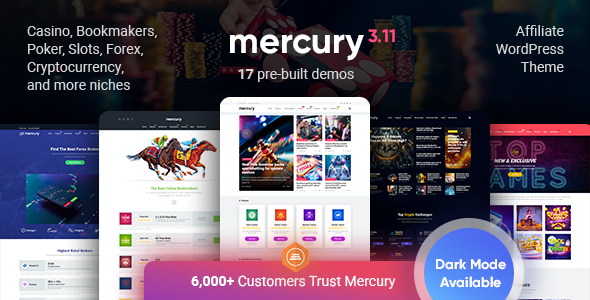
Stuck on your Mercury WordPress theme? Let's fix it.
No endless back-and-forth. Just send us the details and we'll get it done.
No obligation · Replies within 1 hour · Quote within 1 day
Setup · Customization · Bug fixes · WooCommerce integration
About Mercury WP Theme
Mercury is a premium WordPress theme by Space-Themes, built around a clean, minimal aesthetic that suits creative agencies, portfolios, and business sites. It ships with a drag-and-drop page builder, multiple header layouts, and a solid set of pre-built demo pages that cover a wide range of industries.
The theme is coded with performance in mind. It loads fast out of the box and keeps third-party dependencies lean. WooCommerce support is included, making it viable for small product stores alongside content-heavy sites. Mercury also integrates with popular plugins like Contact Form 7, WPML for multilingual builds, and Yoast SEO. If you need a theme that stays out of your way and lets the content speak, Mercury delivers that without a steep learning curve.
Get matched with a Mercury developer in under one day
Tell us about your Mercury project. Small fixes, Mercury theme customization, or a full website build, whatever you need, we've got it covered.
We'll connect you to the right Mercury developers, define the scope, and get everything 100% clear.
You'll get one estimate, hire your preferred developer, and start collaborating.
Finding a reliable Mercury developer used to mean sifting through freelancer platforms with no quality filter. Codeable changes that. Every developer on the platform is vetted through a rigorous application process, so you’re working with someone who actually knows WordPress — not someone who just says they do.
Post your Mercury project, get a free estimate within 24 hours, and only move forward if you’re happy with the proposal. No risk, no commitment until you decide to hire.
Pros
- Fast default load times with minimal bloat from third-party scripts
- Built-in page builder removes the need for a heavy plugin like Elementor on simpler builds
- WooCommerce compatible out of the box with styled product and checkout pages
- WPML compatible, making multilingual builds straightforward without extra configuration
- Clean HTML output that works well with Yoast and Rank Math for on-page SEO
Cons
- The bundled page builder lacks the advanced features of Elementor or Beaver Builder for complex layouts
- Demo import can be unreliable on some hosting environments, requiring manual cleanup
- Documentation from Space-Themes is limited in depth, which makes troubleshooting harder without developer help
- Fewer third-party tutorials available compared to mainstream themes like Astra or Divi
- Header customisation options are useful but limited if you want truly unique navigation structures without custom code
Who is Mercury for?
Creative Agency Websites
Mercury’s minimal design language and flexible grid layouts make it a natural fit for creative agencies. You can build service pages, case study sections, and team profiles without fighting the theme’s defaults. A Mercury expert can extend this further with custom post types for client work or agency-specific landing pages.
Freelance Portfolio Sites
Freelancers benefit from Mercury’s clean portfolio templates and fast loading. Project galleries look sharp without plugin overhead, and the theme’s typography options let personal branding come through. A Mercury developer can wire up a custom contact flow or add filtered portfolio functionality if the defaults aren’t enough.
Small Product Stores
Mercury’s WooCommerce integration handles small catalogues well. Product pages are cleanly styled, cart and checkout flows are functional, and the overall design keeps the focus on products rather than interface noise. For stores with custom requirements, a Mercury specialist can adjust templates and extend functionality without rebuilding from scratch.
Corporate Business Sites
Corporate sites need credibility and clarity. Mercury delivers both with its structured layouts, professional header options, and content-focused design. Service pages, team sections, and contact pages all translate cleanly from the demo to a real business. A Mercury developer can align the build with specific brand guidelines efficiently.
Photography and Visual Showcase Sites
Mercury’s grid system and whitespace handling make photography portfolios look intentional rather than cluttered. Full-width image sections and gallery layouts work well without heavy plugin support. For photographers who want lightbox functionality or client proofing, a Mercury expert can integrate the right tools cleanly.

Customizing Mercury
Mercury gives you a lot of control through the WordPress Customizer. You can switch fonts, adjust colour palettes, change header styles, and modify layout widths without touching any code. The built-in page builder handles most visual arrangements, and shortcodes fill in the gaps for things like buttons, columns, and pricing tables.
That said, deeper changes — custom post type integration, conditional layouts, bespoke WooCommerce templates, or pixel-perfect design work — are easier with a Mercury expert who knows the theme inside out. A Mercury specialist can also help you override default styles cleanly using a child theme, so your customisations survive updates without breaking anything. If your project has specific requirements the Customizer can’t handle, hiring a Mercury developer is the practical route.
Recommended plugins for Mercury
Mercury pairs well with caching plugins like WP Rocket or W3 Total Cache. Combined with image optimisation and a CDN, you can push the theme’s already decent load times significantly further. Check out our WordPress performance service if speed is a priority for your site.
For search visibility, Mercury’s clean HTML structure gives SEO plugins like Yoast and Rank Math a solid foundation to work with. Proper schema markup, meta configuration, and technical SEO audits can make a real difference. Our WordPress SEO optimisation service covers all of that in detail.
Not sure which plugins to use? This WordPress plugins directory covers the most popular options with reviews and setup guides.
Mercury common issues
Mercury theme demo import fails or gets stuck
Demo import failures in Mercury are usually caused by server timeout limits or PHP memory restrictions. Increase max_execution_time to at least 300 seconds and set memory_limit to 256M in your php.ini or wp-config.php. If the import still stalls, try importing content in sections rather than all at once. Some hosting environments also block large XML imports by default — check your server error logs for specific blocks. If you’re stuck, our WordPress bug fixing service can sort this quickly.
Mercury page builder not loading in WordPress editor
If Mercury’s page builder isn’t loading, the most common cause is a JavaScript conflict with another active plugin. Deactivate plugins one by one to isolate the conflict. Also check for browser console errors — they’ll point directly to the conflicting script. Make sure you’re running a supported version of PHP (7.4 or higher recommended). Clearing your browser cache and any server-side cache after each change is important. If you’ve recently updated WordPress core, check whether a theme update from Space-Themes is available to restore compatibility.
Mercury theme styles not updating after changes in Customizer
When Customizer changes don’t reflect on the front end, a caching layer is almost always the cause. Purge your caching plugin cache, CDN cache, and browser cache after saving changes. If you’re using a theme like Mercury without a child theme, check whether a plugin is overriding stylesheets. If you’re on WP Engine, Kinsta, or another managed host, their server-level cache needs to be cleared separately. Persistent issues may indicate a file permission problem or a CSS minification setting that’s serving a stale stylesheet.
WooCommerce pages look unstyled with Mercury theme
Unstyled WooCommerce pages with Mercury usually mean the theme’s WooCommerce support hasn’t been declared, or a plugin conflict is stripping the styles. First, check that Mercury is running an up-to-date version with WooCommerce compatibility declared. Add add_theme_support('woocommerce'); in a child theme if it’s missing. Deactivate other plugins temporarily to rule out style conflicts. If cart or checkout pages look broken specifically, a missing template file or a conflicting page builder wrapper is likely the cause. A Mercury specialist can diagnose this fast.
Mercury theme header logo not displaying correctly
Logo display issues in Mercury are typically caused by image size constraints in the Customizer or a cached version of the old logo being served. Go to Appearance > Customizer > Header and re-upload the logo. Make sure the image is an SVG or PNG with a transparent background at 2x resolution for retina screens. If the logo appears but at the wrong size, check whether custom CSS from a previous developer is overriding the header styles. Clear all caches after making changes and test in an incognito window to confirm.
Mercury theme breaking after WordPress update
Mercury theme breaking after a WordPress update is a sign that the theme hasn’t been updated to match changes in WordPress core. Check the Space-Themes changelog for a compatible Mercury version and update the theme. If you haven’t been using a child theme, updates may have overwritten custom code. Going forward, always use a child theme for any customisation. If the break is happening now and your site is down, our WordPress bug fixing service can restore functionality quickly and safely.
Mercury child theme not inheriting parent styles
If your Mercury child theme isn’t inheriting parent styles, the most likely cause is a missing or incorrect @import call in the child theme’s style.css, or an incorrectly written functions.php that isn’t using wp_enqueue_scripts to load the parent stylesheet. Do not use @import in the stylesheet header alone — enqueue both parent and child stylesheets properly in functions.php. Check that the child theme’s Template: header in style.css exactly matches the parent theme’s folder name.
Mercury theme contact form not sending emails
Contact form email failures in Mercury are rarely the theme’s fault directly. Most often the issue is with your hosting server’s mail configuration. WordPress uses PHP mail by default, which many hosts block. Install an SMTP plugin like WP Mail SMTP and connect it to a transactional email service such as Mailgun, SendGrid, or your own Gmail account. Test the connection using the plugin’s built-in test tool. Also check spam folders before assuming emails aren’t sending. If forms aren’t submitting at all, a JavaScript conflict or missing form plugin update is more likely the cause.
Mercury theme mobile menu not working or not opening
A non-functional mobile menu in Mercury is usually a JavaScript error preventing the toggle script from running. Open your browser’s developer tools on mobile emulation and check the console for errors. Common causes include a jQuery conflict, a caching plugin serving an old version of the theme’s JS files, or a third-party plugin that registers its own jQuery version. Clear all caches first, then test with plugins deactivated. If the issue only appears on specific devices, a CSS media query override may be hiding the menu button rather than a JS failure.
Mercury theme slow loading on shared hosting
Mercury loads well on decent hosting, but shared hosting introduces bottlenecks. Start by installing a caching plugin (WP Rocket or LiteSpeed Cache depending on your server), optimising images with a plugin like ShortPixel, and enabling GZIP compression. Reduce external HTTP requests by combining scripts where possible. If your host caps PHP workers or memory aggressively, a server upgrade will have more impact than any plugin. For a full performance audit and implementation, our WordPress performance service covers everything end to end.
Mercury FAQ
Mercury is reasonably beginner-friendly. The Customizer covers most visual changes without code, and the page builder handles basic layouts. Where it gets harder is when you move beyond the demo — custom layouts, plugin integration, and troubleshooting require more experience. For beginners with specific build requirements, working with a Mercury developer is faster and cheaper than learning the hard way.
Mercury has its own page builder built in, and it does work alongside Elementor, but mixing the two isn’t always clean. Elementor can override Mercury’s layout wrappers, which sometimes causes width and spacing issues. Most developers choose one or the other for a build rather than running both. If Elementor is your preference, a Mercury specialist can configure the theme to hand off layout control properly.
If you’ve been editing Mercury’s core files directly, an update will overwrite your changes. The fix is to move all customisations into a child theme before updating. Once that’s done, updates to the parent theme are safe. Always back up your site before applying any theme update. If you haven’t set up a child theme yet, a Mercury developer can migrate your customisations cleanly before the next update.
Space-Themes releases updates to maintain Mercury compatibility with WordPress core. Check the theme’s changelog and the Space-Themes website for the latest confirmed compatibility. If you’re running an older version of Mercury on WordPress 6.x and seeing issues, updating the theme is the first step. Persistent compatibility problems after updating are worth raising with a Mercury expert.
Yes. Mercury includes WooCommerce support with styled product pages, archive layouts, cart, and checkout templates. It works well for small to medium catalogues. For larger stores with custom product types, complex filtering, or subscription products, you’ll likely need a Mercury developer to extend the default WooCommerce templates to match your requirements.
Mercury is listed as WPML compatible. You can run multilingual sites using the WPML plugin without needing custom theme modifications in most cases. Language switchers, translated page builder content, and RTL layouts all work with the standard WPML setup. Complex multilingual builds with custom post types or region-specific layouts may need a Mercury specialist to configure correctly.
If a Mercury update has broken your site, the quickest fix is to restore from a backup and then apply the update again more carefully — ideally on a staging environment first. If you don’t have a backup, you may need to re-upload the previous theme version via FTP and deactivate the update. For sites that are down with no backup, our WordPress bug fixing service can recover the situation.
Mercury is relatively lean compared to themes that bundle Elementor or Visual Composer as a dependency. On good hosting with basic caching, it performs well. The main performance risks come from unoptimised images, too many active plugins, or cheap shared hosting. Mercury itself isn’t a bottleneck in most setups. If your site is slow, the problem is almost always elsewhere in the stack.
Yes, and it’s often the fastest way to get exactly what you need. A vetted Mercury developer can handle anything from small visual tweaks to full custom layouts, WooCommerce modifications, or performance work. Through Codeable, you can post your project and get a free estimate from an experienced Mercury specialist without any commitment to hire until you’re satisfied with the proposal.
Space-Themes produces several themes with different design focuses. Mercury sits at the cleaner, more minimal end of their range, making it better suited for creative and professional sites than themes targeting specific niches like restaurants or real estate. If Mercury’s aesthetic fits your project, its lightweight build and flexible layouts are genuine strengths. If you’re unsure which Space-Themes product fits your use case, a WordPress developer familiar with the range can advise.
Hire a Mercury Developer or Mercury Expert
Whether you need a full Mercury build, a specific customisation, or ongoing support, working with a vetted developer saves time and avoids costly mistakes. Our Mercury specialists on Codeable have hands-on experience with Space-Themes products and know exactly how to extend or modify Mercury without breaking your site.
Get a Free Estimate and describe your project. You’ll hear back within 24 hours.
You'll need a free Codeable account so developers can ask questions and send their quotes.