Navian WordPress Theme
by THEMELOGI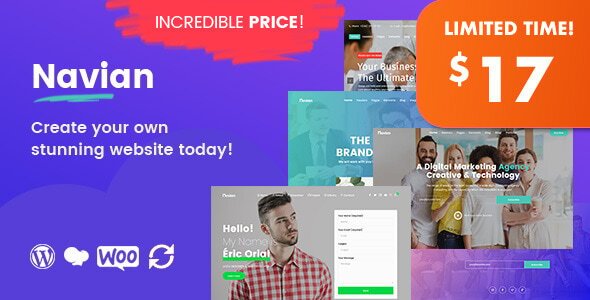
Stuck on your Navian WordPress theme? Let's fix it.
No endless back-and-forth. Just send us the details and we'll get it done.
No obligation · Replies within 1 hour · Quote within 1 day
Setup · Customization · Bug fixes · WooCommerce integration
About Navian WP Theme
Navian is a multipurpose WordPress theme by THEMELOGI, built for agencies, freelancers, and service-based businesses. It ships with a clean layout system, multiple header styles, and a page builder-friendly structure that works with Elementor out of the box.
The theme is designed to cover a wide range of business niches without feeling bloated. Demo content is available for quick setup, and the theme follows current WordPress coding standards. THEMELOGI maintains regular updates, which keeps Navian compatible with newer versions of WordPress and popular plugins.
If you need a business site that looks polished without months of custom development, Navian gives you a solid starting point. That said, most real projects will require some developer work to get the layout, performance, and functionality exactly right.
Get matched with a Navian developer in under one day
Tell us about your Navian project. Small fixes, Navian theme customization, or a full website build, whatever you need, we've got it covered.
We'll connect you to the right Navian developers, define the scope, and get everything 100% clear.
You'll get one estimate, hire your preferred developer, and start collaborating.
Most Navian projects reach a point where the visual editor isn’t enough. Whether it’s a custom template, a broken layout after an update, or a feature that doesn’t exist in the theme by default, you need someone who knows the code. Codeable connects you with vetted WordPress developers who have worked with themes like Navian across dozens of real projects. You get a free estimate before any commitment, and work only starts when you approve it. No agencies, no juniors assigned to your job.
Pros
- Clean, minimal code base from THEMELOGI with regular update cycles
- Full Elementor compatibility out of the box with pre-built section templates
- Multiple header and footer layout options without needing a separate plugin
- Demo importer works reliably and gets a baseline site running quickly
- Responsive layouts hold up well on mobile without major CSS overrides
Cons
- Default demo assets add page weight that needs to be cleaned up before launch
- WooCommerce styling requires custom CSS to match the rest of the theme properly
- Limited built-in blog layout options compared to dedicated blog themes
- Some Customizer options only apply to specific demos, not globally
- THEMELOGI support response times can be slow during high-volume periods
Who is Navian for?
Digital Agencies
Navian’s agency-oriented demos include service listings, team sections, and case study layouts. A Navian developer can adapt these into a fully branded site with custom post types for client work and filterable portfolio grids. The Elementor compatibility means the team can manage content after launch without touching code.
Freelance Portfolios
Freelancers get a lot of mileage from Navian’s clean single-page layouts. The theme handles project showcases, testimonials, and contact sections without needing extra plugins. A Navian specialist can strip the demo down to just what you need, tighten the typography, and make the site feel custom rather than templated.
SaaS Landing Pages
Navian’s above-the-fold section options work well for SaaS-style hero layouts with feature breakdowns and pricing tables. You’ll need a developer to wire up any interactive elements or integrate a third-party billing or onboarding tool, but the base structure saves significant design time at the start of the build.
Consulting Firms
Consulting sites need clear service pages, credibility signals, and strong calls to action. Navian’s header options and content blocks support this pattern directly. A Navian expert can build out individual service pages with consistent layouts, structured data for SEO, and form integrations for lead capture without custom theme development from scratch.
Local Service Businesses
Trades, clinics, and local businesses benefit from Navian’s straightforward layout system. The theme handles location pages, service descriptions, and contact information clearly. With a bit of developer work, you can add local SEO schema, Google Maps embeds, and appointment booking integrations that convert local search traffic into enquiries.

Customizing Navian
Navian’s Customizer options cover typography, colors, header layouts, and footer structure. For most visual changes, you can work within Elementor and adjust section by section. But anything beyond surface-level styling, custom post types, conditional logic, or third-party API integrations, will need developer work.
A Navian expert can reconfigure the theme’s layout system to match your exact design spec, strip out unused demo content, and build custom templates for specific page types. This is especially useful if you’re running an agency or SaaS site where the default demos don’t map cleanly to your content model.
THEMELOGI provides documentation, but gaps appear quickly when you move into advanced territory. Working with a developer who knows Navian well saves time and avoids the workarounds that tend to break on the next update.
Recommended plugins for Navian
Navian works with the standard stack of WordPress plugins. WooCommerce integration is possible with some styling work. For contact forms, WPForms or Gravity Forms slot in cleanly. WPML is supported for multilingual builds.
If you’re pushing Navian for a client site, pay close attention to WordPress performance from the start. The theme loads several assets by default, and without proper caching and image optimisation, page speed will suffer. For content-heavy sites, pairing Navian with a solid WordPress SEO setup ensures the clean structure of the theme actually pays off in search rankings.
Not sure which plugins to use? This WordPress plugins directory covers the most popular options with reviews and setup guides.
Navian common issues
Navian header not showing correctly on mobile
Mobile header issues in Navian are usually caused by a conflicting hamburger menu script or a custom CSS rule overriding the theme’s breakpoint. Check the mobile menu settings under Appearance > Customize > Header. Clear any custom CSS that targets the nav wrapper and test in a private browser window. If the issue appeared after a plugin install, deactivate plugins one by one to isolate the conflict. A WordPress bug fixing specialist can trace this quickly.
Navian Elementor sections not loading after update
After a Navian or Elementor update, saved templates can break if the widget register has changed. Go to Elementor > Tools > Regenerate CSS and clear the cache. If sections still fail to render, check the browser console for JavaScript errors. A mismatch between Navian’s bundled Elementor widgets and the installed Elementor version is the most common cause. Downgrade or update one side to align them.
Navian demo import fails or gets stuck
Navian demo imports fail most often due to PHP memory limits or execution time being too low on shared hosting. Set memory_limit to at least 256MB and max_execution_time to 300 in your php.ini or wp-config.php. If the import still stalls, try importing XML content and widgets separately. Contact THEMELOGI support with the error log if the one-click importer keeps timing out. Get help from a WordPress bug fixing expert if the issue persists.
Navian footer widgets not displaying
If Navian footer widgets are not showing, first check Appearance > Widgets and confirm content is assigned to the correct footer widget areas. Some Navian demos use a different number of footer columns, and switching demos can orphan widgets in areas that no longer exist. Check your active footer layout under Customizer > Footer and make sure the widget areas match the columns selected.
Navian custom fonts not applying site-wide
Custom fonts in Navian need to be applied through the Customizer under Typography settings. If a Google Font isn’t reflecting, check that the font is actually loaded by inspecting the page source for the Google Fonts URL. If you’re using a custom font file, it needs to be properly enqueued via functions.php. Caching plugins can also prevent font changes from showing. Purge all caches after making typography changes.
Navian page builder layout broken after WordPress update
WordPress core updates occasionally break theme templates when deprecated functions are removed. If your Navian layout breaks after a WordPress update, check the PHP error log first. Common culprits are calls to functions removed in newer PHP or WordPress versions. Update Navian to the latest version from THEMELOGI and check if the issue resolves. If not, a WordPress bug fixing developer can patch the specific function conflict.
Navian WooCommerce shop page layout issues
Navian doesn’t ship with deep WooCommerce template overrides, so the shop page often inherits mismatched styles from the default WooCommerce stylesheet. Use a child theme to copy woocommerce/templates/archive-product.php and adjust the grid to match Navian’s layout. Also check that Navian’s WooCommerce compatibility is enabled under theme settings. Some layout issues are simply missing CSS rules for product cards.
Navian logo not updating in Customizer
If the Navian logo isn’t updating after you change it in Customizer, the most likely cause is an aggressive caching layer. Purge your server cache, CDN cache, and browser cache together. If the old logo persists, check whether a logo is also hardcoded in a custom CSS rule using a background-image property. Some child theme setups duplicate the logo definition and override the Customizer setting.
Navian blog page showing wrong template
Navian uses a dedicated blog template that can be overridden by a page template set incorrectly in the Page Attributes panel. Go to the page you set as your Posts page in Settings > Reading, edit it, and check that no custom page template is selected in the sidebar. It should use the default template. Also confirm the page is assigned as the blog page in Settings > Reading, not just named blog.
Navian CSS not loading on some pages
Missing CSS on certain Navian pages usually points to a stylesheet enqueue condition, a CSS minification error, or a page caching issue that stored a version of the page before the stylesheet was loaded. Deactivate your caching plugin and reload the affected page. If styles return, adjust your caching plugin’s exclusion rules. If you’re using a CDN, check whether the stylesheet URL is being rewritten incorrectly.
Navian FAQ
Yes, Navian is built with Elementor compatibility as a core feature. Most of its demo layouts are built using Elementor, and the theme registers custom widget areas that work within the Elementor editor. You’ll need the free version of Elementor at minimum, though some advanced layout features benefit from Elementor Pro.
Navian supports WooCommerce, but the out-of-the-box styling is basic. The shop archive, single product, and cart pages will function, but you’ll likely need custom CSS or a developer to align the WooCommerce templates with the rest of the Navian design. A Navian developer can handle this cleanly using a child theme.
After installing and activating Navian, navigate to Appearance > Import Demo Data. Choose your preferred demo from the list and click import. The process can take a few minutes depending on your hosting environment. Make sure your PHP memory limit is set to at least 256MB before starting to avoid the import timing out.
Navian works with the native WordPress block editor (Gutenberg) if you prefer not to use Elementor. The theme’s core layouts and templates render properly without a page builder. However, the demo content is built with Elementor, so if you want to match the demo look exactly, you’ll need Elementor installed.
Navian outputs clean HTML and uses proper heading hierarchy, which gives it a reasonable SEO foundation. It also supports schema markup through plugins like Yoast or Rank Math. That said, theme structure alone doesn’t determine rankings. Pairing Navian with a proper WordPress SEO strategy is what actually moves the needle.
Create a folder in wp-content/themes/ named navian-child. Add a style.css file with the required theme header referencing Navian as the parent theme, and a functions.php that enqueues the parent stylesheet. Activate the child theme from Appearance > Themes. All customisations should go into the child theme to survive Navian updates from THEMELOGI.
Navian is listed as WPML-compatible. String translations, page translations, and language switcher placement all work through the WPML plugin. You’ll need WPML and the String Translation add-on for full coverage. Some theme strings may need to be registered manually if they don’t appear in the WPML string translation panel automatically.
Codeable is the most reliable option for finding a vetted Navian developer. Post your project, describe what you need, and get matched with a specialist within 24 hours. You receive a free estimate before any work begins. Get a free estimate here and have your Navian project scoped without obligation.
Navian loads several scripts and stylesheets by default, especially when demo content is active. Common causes of slow load times include unoptimised images, unused Elementor widget scripts, and no caching layer in place. Start with a performance audit, then address image sizes, enable caching, and consider a CDN. See our WordPress performance service for a structured approach.
Yes, you can migrate an existing WordPress site and switch the active theme to Navian. The content itself transfers fine, but your existing page layouts will need to be rebuilt using Navian’s templates and Elementor sections. If you’re moving from a different host as well, our WordPress migration service handles the technical side cleanly.
Hire a Navian Developer for Your WordPress Project
If your Navian site needs custom work, whether that’s a layout build from scratch, plugin conflicts fixed, or a full redesign using the theme’s structure, working with a specialist is faster than trial and error. Our developers on Codeable handle Navian projects daily. Get a free estimate and have a developer scoped to your project within 24 hours, no obligation to proceed.
You'll need a free Codeable account so developers can ask questions and send their quotes.